

Real-Time RF Threat Detection & Signal Intelligence
for Contested Electromagnetic Environments
 Spectral Sentry
 is a browser-based RF spectrum analysis and signal intelligence platform designed for operators who need to know what's in the electromagnetic environment — and act on it immediately.
Connecting to commercial-off-the-shelf wideband receivers from Signal Hound, RTL-SDR, and HackRF-class hardware, Spectral Sentry delivers real-time spectrum visualization, automated signal detection, and threat classification directly to any networked browser — no specialized workstation required.
From detecting a UAS datalink handshake to intercepting a wideband SAR downlink, Spectral Sentry gives operators the situational awareness needed to identify, classify, and report RF threats before they become a problem. Priority detections broadcast instantly to TAK-based common operating pictures via native Cursor-on-Target messaging.
Signature-based detection against a persistent emitter database instantly classifies UAS datalinks, SATCOM beacons, cellular, and tactical comms. Known threats surface as priority alerts in under 50 ms.
Wideband spectrum coverage up to 43.5 GHz provides high probability of intercept against ISR payloads including synthetic aperture radar downlinks, SIGINT platforms, and EO/IR data links — all identified in real time.
Capture a baseline spectral fingerprint of a known-clean environment, then automatically highlight any new or anomalous signals that appear. Novel emitters surface immediately regardless of classification.
Priority detections broadcast natively to ATAK, WinTAK, and TAK Server. High-priority emitters escalate automatically, and sensor position, field of view, and emitter details appear on every common operating picture.
Browser-native waterfall and FFT displays update at up to 20 fps. Adjust threshold, detection sensitivity, and track timeout in real time. SVR (Spectrum Video Recordings) ring-buffer enables instant playback of any detection event.
Every confirmed signal track writes to a persistent emitter database keyed by frequency and signal type. Duty cycle, peak RSSI, bandwidth, and first/last seen timestamps accumulate across sessions to build an evolving electromagnetic order of battle.
Spectral Sentry's detection engine continuously compares the live spectrum against an adaptive baseline, flagging any signal that crosses a configurable threshold. Confirmed tracks are automatically cross-referenced against the emitter database and classified by frequency, bandwidth, and spectral signature — within a single 50 ms frame.
The screenshot shows Spectral Sentry in action against a live RF environment, simultaneously tracking Spaceborne S-Band SAR High and Medium Resolution downlinks, Iridium satellite TDMA bursts, and ISM band emitters — all classified and prioritized in real time across a 450 MHz to 10.5 GHz sweep.
Wideband coverage with Signal Hound hardware provides high probability of intercept against ISR payloads including SAR operating in S, C, X, Ku, and Ka bands. The waterfall's temporal record makes intermittent spaceborne downlinks — invisible to an instantaneous snapshot — immediately apparent.
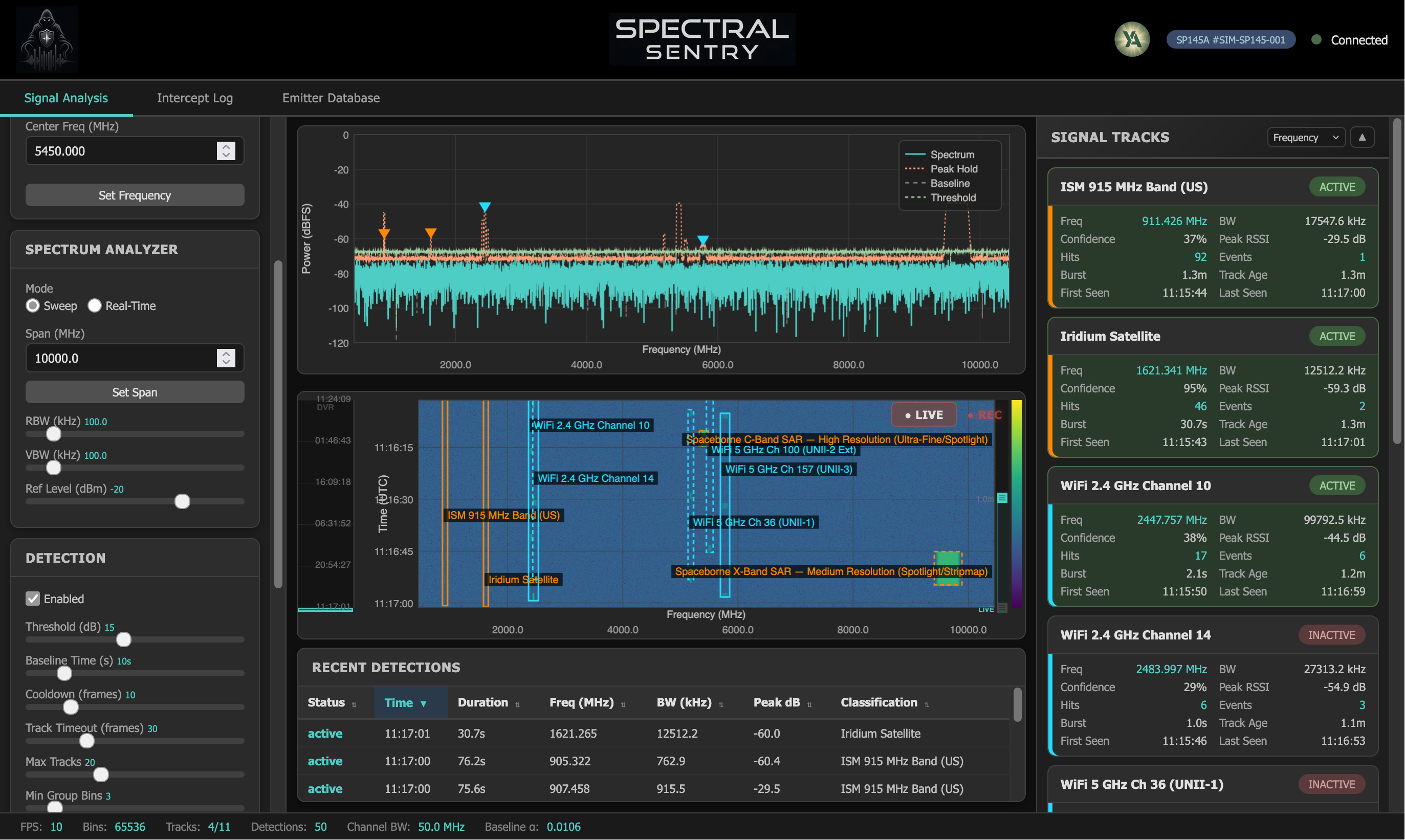
LIVE ISR CAPTURE · SM200B · SPACEBORNE SAR + IRIDIUM SATELLITE + ISM BAND DETECTIONS
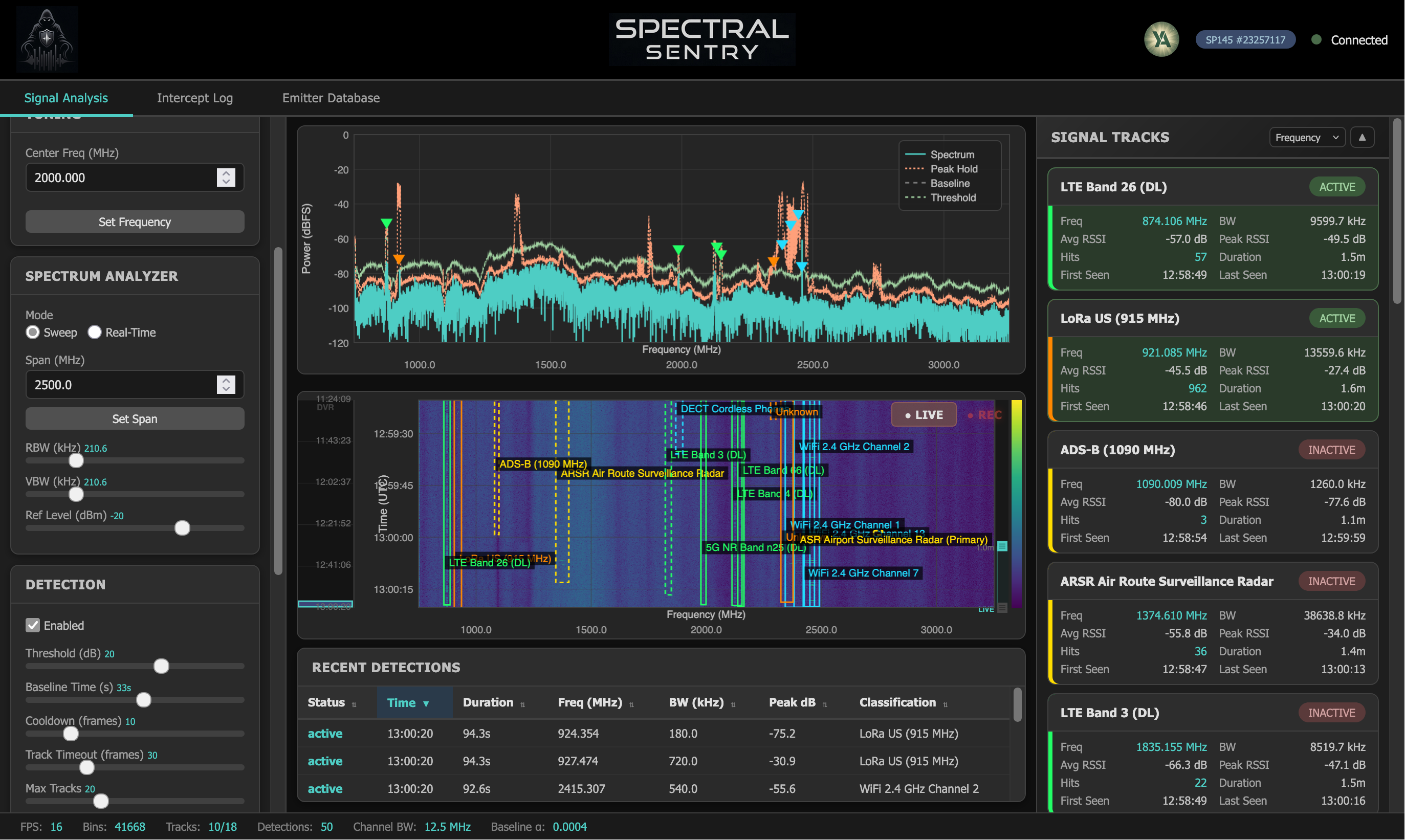
ISM BAND LIVE · LoRa 915 MHz · ADS-B 1090 MHz · ARSR RADAR · LTE · WiFi 2.4 GHz · ANNOTATED WATERFALL
The spectrum display delivers a real-time frequency plot, scrolling waterfall, and detection event table simultaneously in any web browser — no software installation, no specialized hardware at the operator station.
The waterfall provides the temporal view critical for characterizing intermittent emitters: burst-mode UAS controllers, TDMA satellite slots, and pulsed radar signals all leave distinctive patterns that an instantaneous FFT snapshot misses. SVR (Spectrum Video Recordings) storage captures every frame so operators can scrub back to any moment in the session.
Signal tracks appear in the detection table within a single frame of first detection, with frequency, bandwidth, peak RSSI, and database classification ready for immediate assessment. Threshold, baseline window, and track timeout are all adjustable live without interrupting the stream.
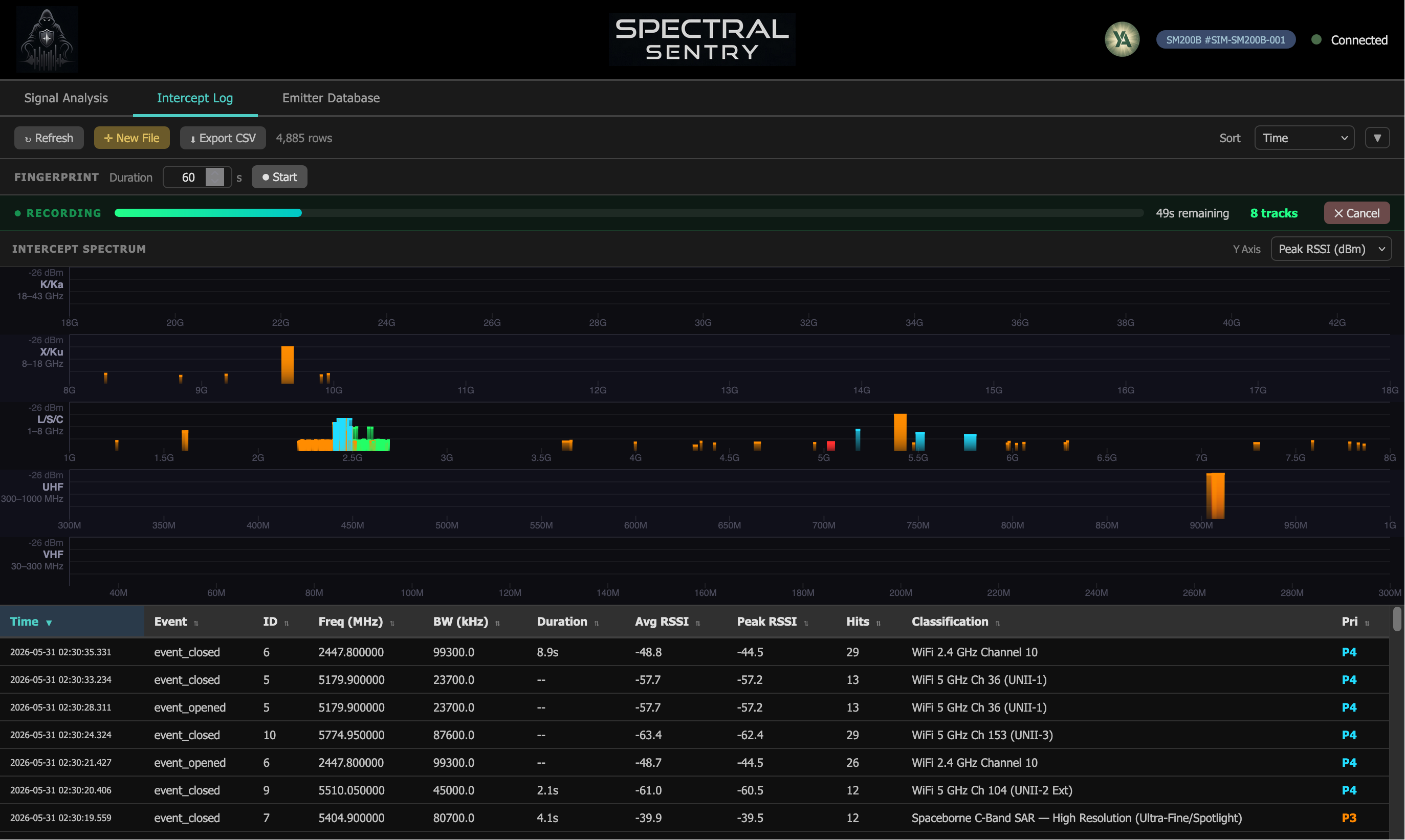
FINGERPRINT RECORDING · 8 TRACKS · INTERCEPT SPECTRUM VHF–X/Ka · SPACEBORNE C-BAND SAR DETECTED
Signature-based detection only catches what you already know. Spectral Sentry's RF fingerprinting engine detects signals that have no name — anything that wasn't present when the environment was last known clean.
Operators capture a timed baseline fingerprint of a controlled environment, recording every confirmed signal track — frequency, bandwidth, duty cycle, RSSI profile, and temporal behavior. When the environment is later monitored against that baseline, any new emitter triggers an immediate Priority 1 alert, highlighted in red across the spectrum display, track list, and TAK common operating picture.
The capture shows a live fingerprint session with 8 active tracks, the Intercept Spectrum visualization spanning VHF through X/Ka-band simultaneously, and the event log capturing a Spaceborne C-Band SAR — High Resolution (Ultra-Fine/Spotlight) pass — exactly the kind of ISR signal that fingerprinting reveals the moment it appears.
Every confirmed signal track writes to a persistent emitter database keyed by frequency and classification. Across sessions, the database accumulates bandwidth statistics, duty cycle profiles, RSSI envelopes, and first/last seen timestamps — building a continuously refined electromagnetic order of battle for the monitored environment.
The database ships pre-loaded with hundreds of reference entries spanning airport surveillance radar, NEXRAD weather radar, spaceborne SAR modes, UAS datalinks, 5G/LTE bands, SATCOM downlinks, and UAV command & control frequencies — giving operators named classifications from the first detection without manual configuration.
Operators can add, edit, and annotate entries directly from the UI — labeling unknown signals captured during fingerprint sessions and assigning them to threat priority tiers. Emitter libraries export and share across nodes and integrate with external analysis tools.
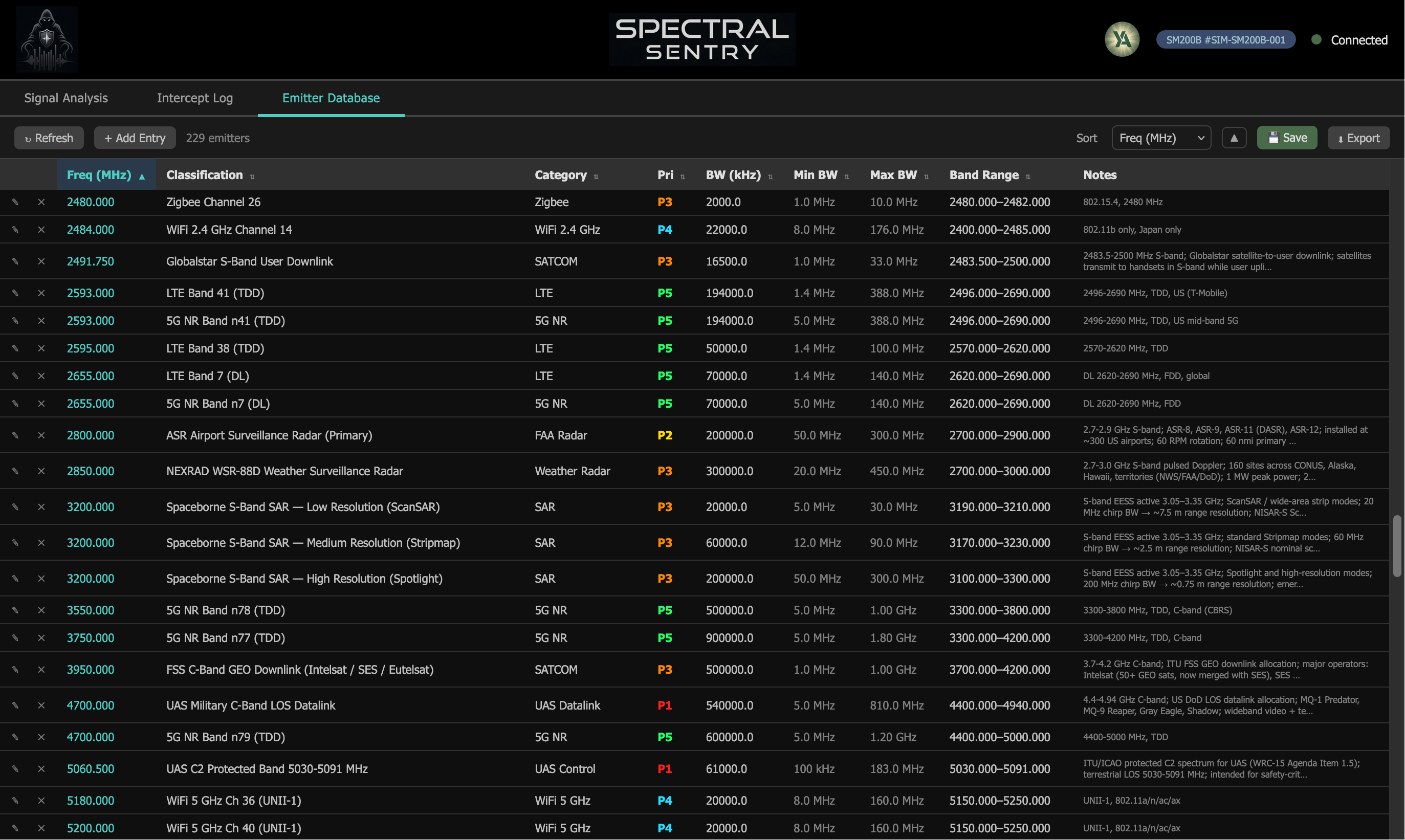
EMITTER DATABASE · 229 ENTRIES · SAR · RADAR · SATCOM · UAS · LTE · 5G · TACTICAL COMMS
The window between detecting a threat and acting on it is measured in seconds. Spectral Sentry collapses that window to near-zero with native Cursor-on-Target integration that broadcasts signal detections directly to ATAK, WinTAK, and TAK Server — no manual reporting, no relay delay.
In normal operation the sensor maintains a live overlay on the common operating picture. When a priority emitter is active, broadcasts escalate automatically, pushing current emitter details to every TAK device on the network while the threat is live.
COT messages carry full sensor identity, live GPS position, and structured emitter detail — readable by operators and consumable by downstream TAK-integrated systems. The screenshots show the complete loop: P1 alert in Spectral Sentry and the resulting callout on a live ATAK device.
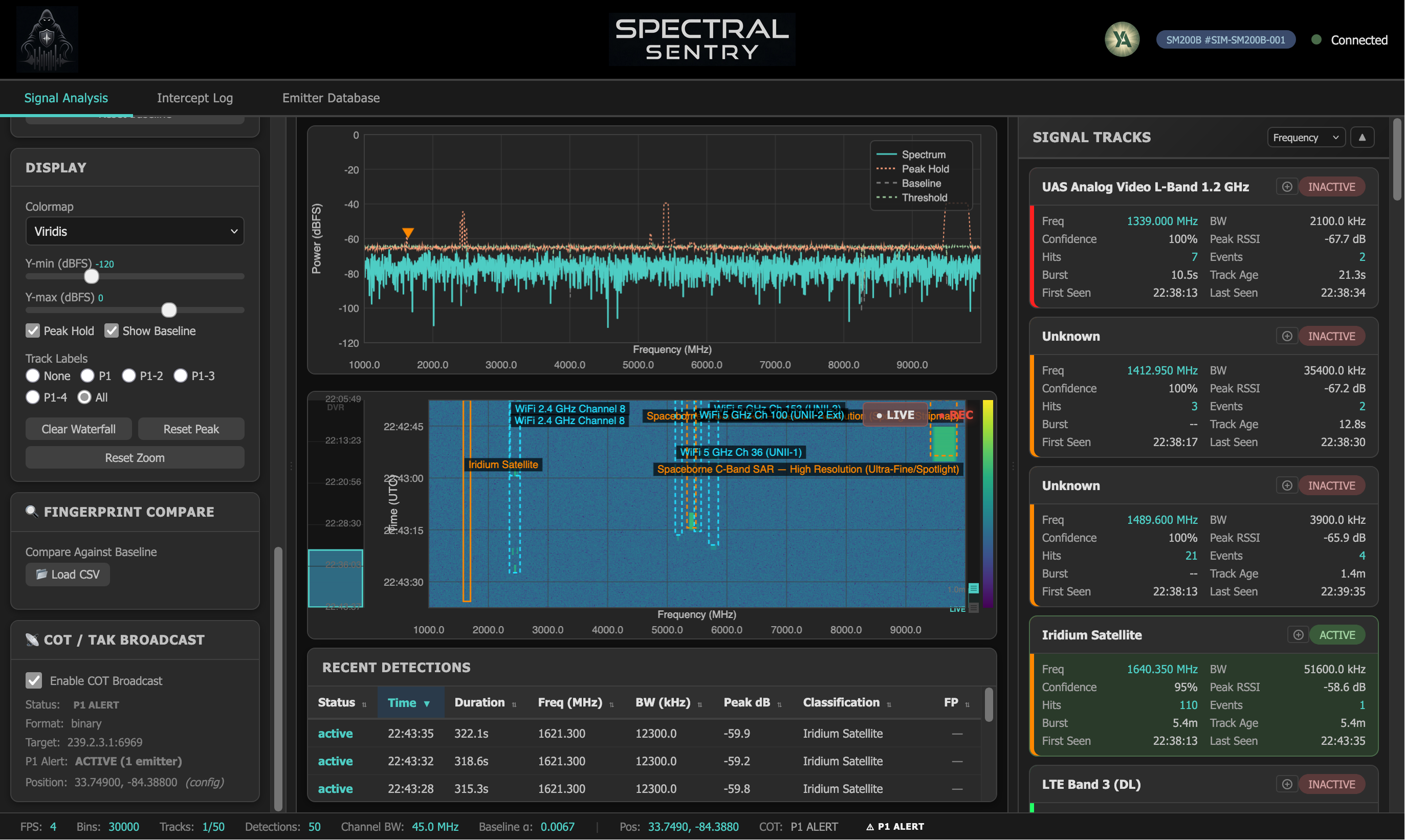
SPECTRAL SENTRY · P1 ALERT · COT BROADCAST ACTIVE · 1 SEC INTERVAL
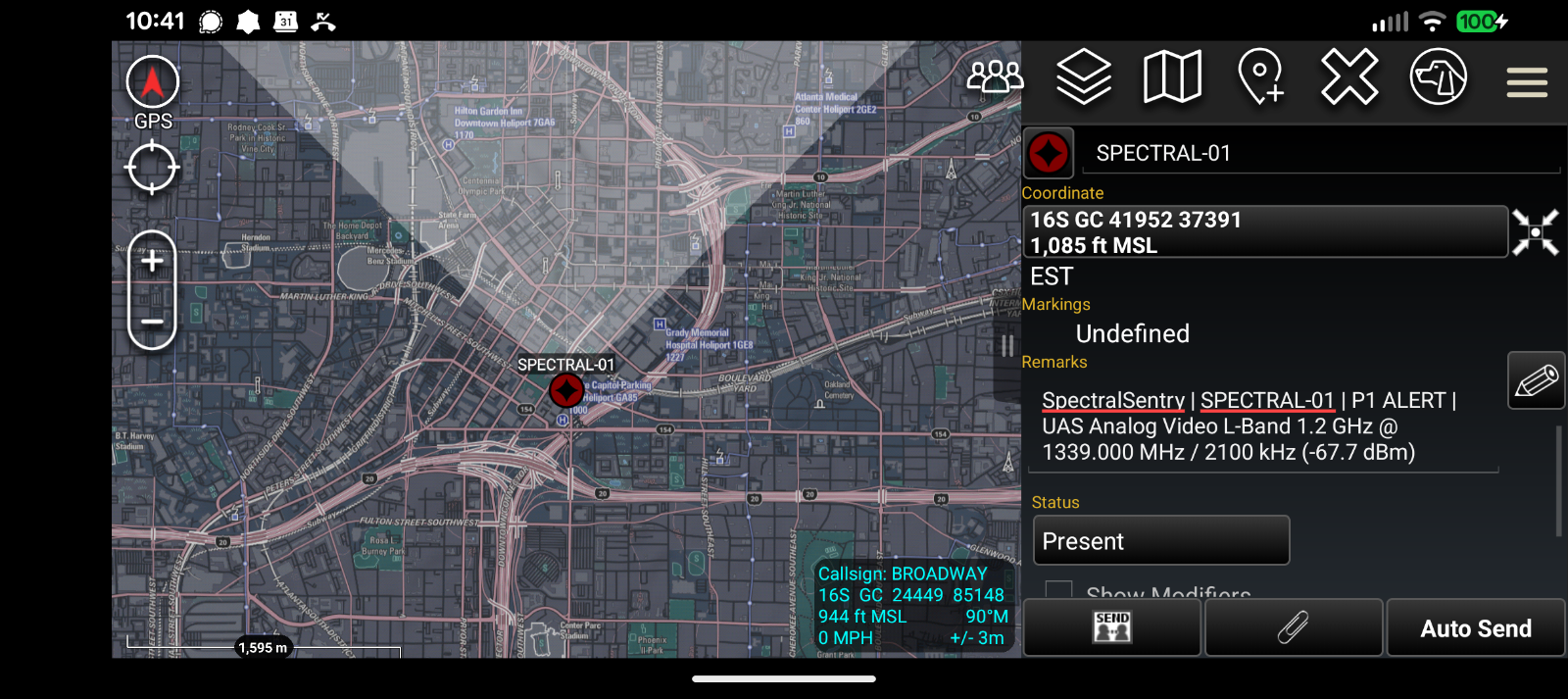
ATAK COP · SPECTRAL-01 SENSOR · P1 UAS ANALOG VIDEO L-BAND · 1339 MHz / -67.7 dBm
The operator interface is fully responsive and installable as a Progressive Web App. Every capability — live spectrum, waterfall SVR, signal tracks, intercept log, and the emitter database — runs at full fidelity on a phone or tablet, with a touch-first layout and nothing to install from an app store.
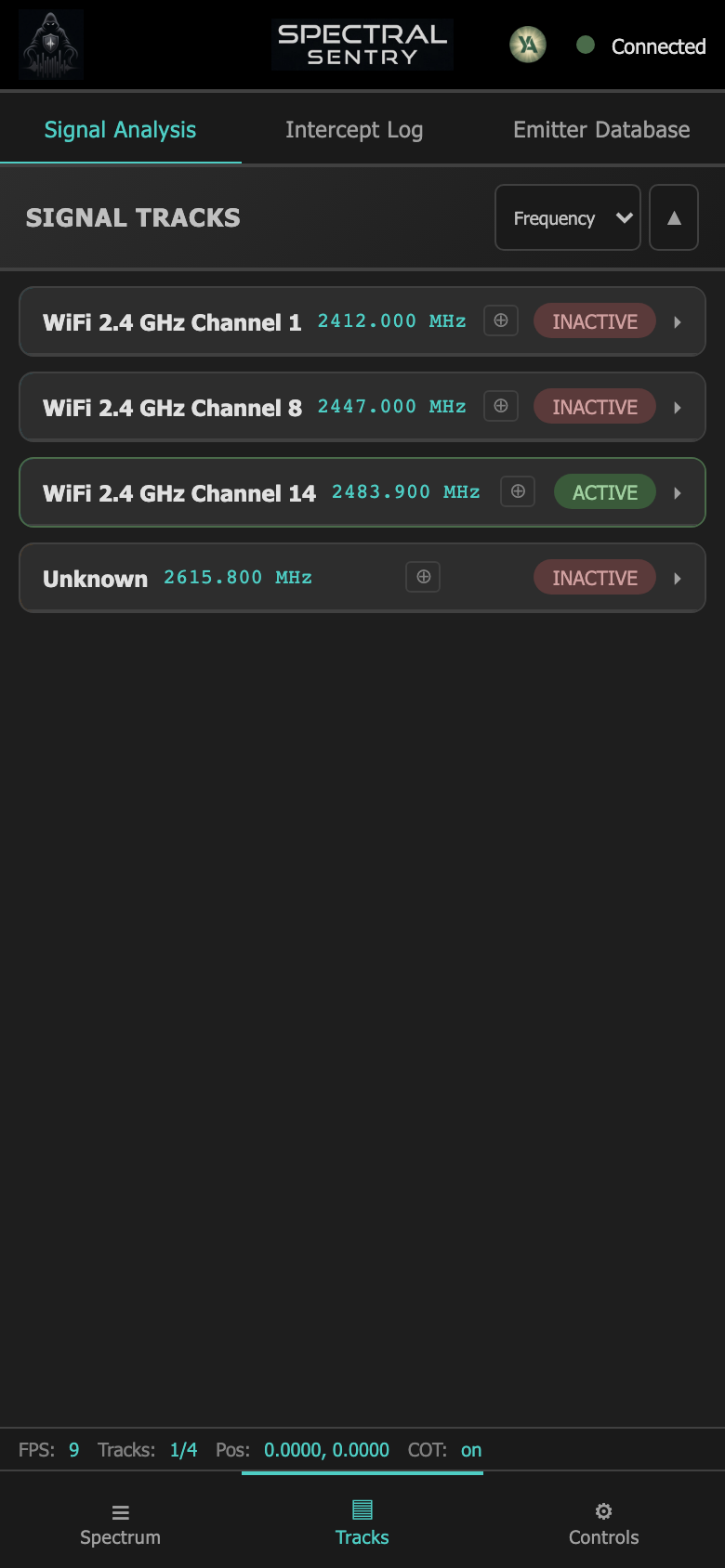
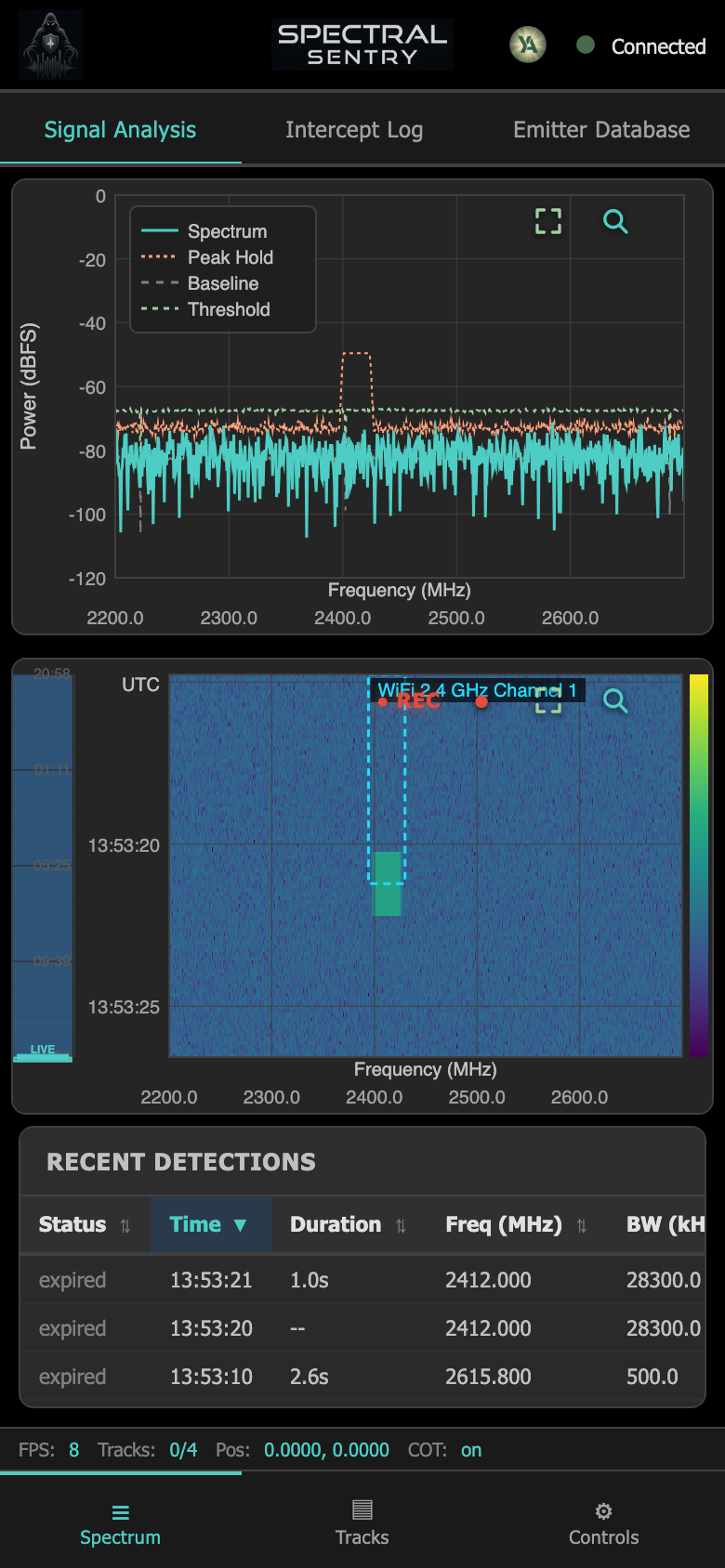
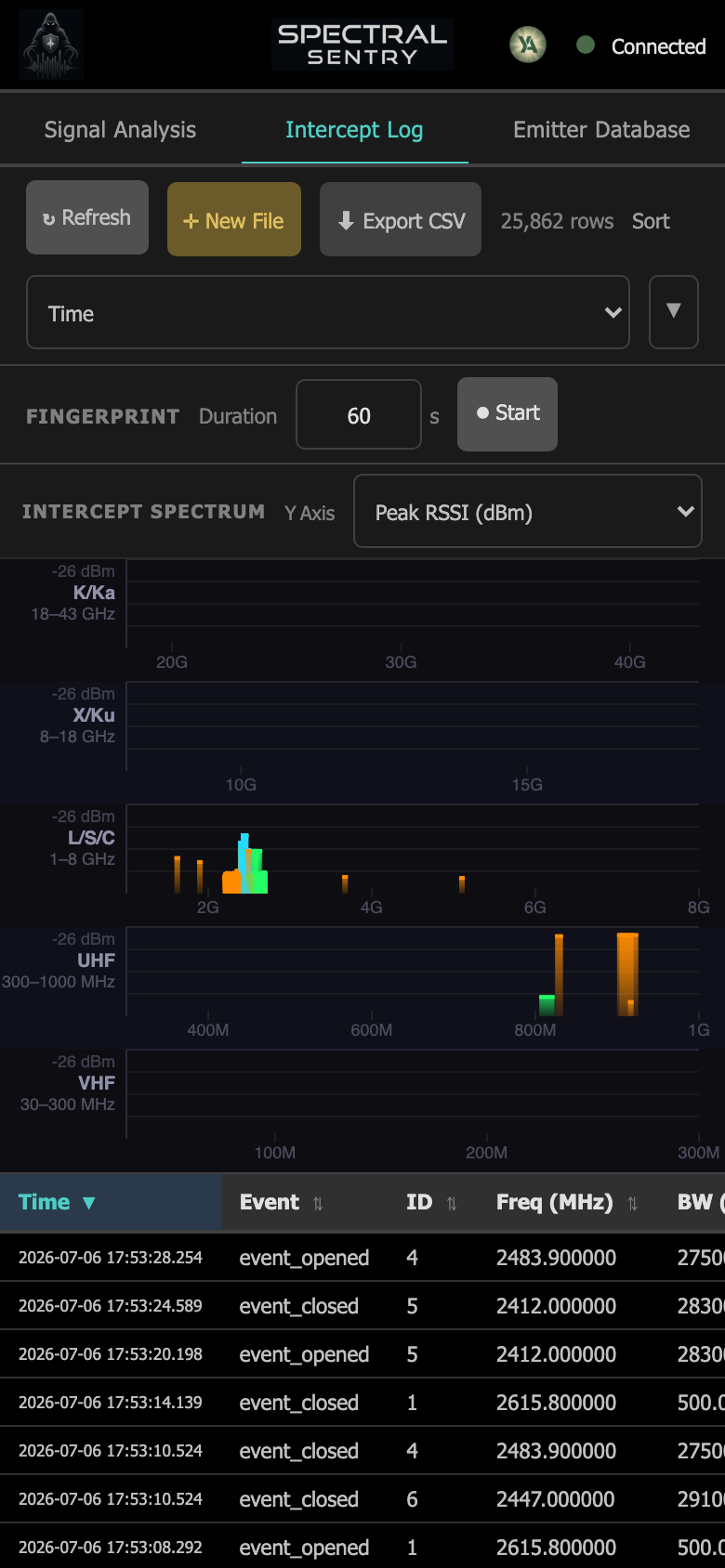
Spectral Sentry terminates TLS directly in the sensor — no reverse proxy, no extra services. Every byte between the operator's browser and the sensor, including the live wss:// spectrum stream, is encrypted and integrity-protected.
For a field LAN or mesh reached by IP address — where public DNS and public certificate authorities don't exist — Sentry issues certificates from a small internal CA with IP SANs. Installing that CA root on operator devices makes the connection warning-free, PWA-installable, and cryptographically bound to the sensor: operators know the node they're talking to is the real one, and the link cannot be silently intercepted.
A commercial wideband receiver streams live RF spectrum data to the Spectral Sentry engine — from compact ISR-band analyzers down to low-cost VHF/UHF receivers.
The detection engine identifies signal tracks in real time. Each confirmed track is cross-referenced against the emitter database and assigned a priority classification automatically.
Operator-initiated fingerprint sessions compare the current emission environment against a stored baseline. New, unrecognized emitters are immediately elevated to Priority 1 and visually differentiated from known signals.
Priority 1 detections trigger an immediate COT broadcast to the TAK common operating picture. Sensor position, emitter frequency, bandwidth, and RSSI appear on every ATAK/WinTAK device on the network within one second.
Spectral Sentry connects to commercial off-the-shelf receivers spanning narrowband VHF to Ka-band, enabling deployment across a wide range of platforms and budgets without purpose-built hardware.
High-dynamic-range sweep spectrum analyzer. Excellent for UAS datalink bands (900 MHz, 2.4 GHz, 5.8 GHz) and S/C/X-band ISR. Compact USB form factor enables drone-deployable or handheld configurations.
Wide frequency coverage through Ku-band. Optimized for ISR downlink intercept and SATCOM monitoring. High sensitivity enables detection of low-power burst signals at operationally relevant ranges.
Extends coverage through Ka-band for intercept of wideband SAR downlinks and millimeter-wave ISR payloads. Highest probability of intercept against advanced airborne sensor systems in contested environments.
Cost-effective entry point for VHF/UHF monitoring. Ideal for tactical comms interception, APRS tracking, and ADS-B surveillance. Pairs with a wideband receiver for comprehensive dual-band coverage.
The server component runs on any Linux host including Raspberry Pi 4/5, NVIDIA Jetson, or Intel NUC. Browser-based UI requires no software installation on the operator workstation.
Multiple Spectral Sentry nodes share a single TAK COP, each reporting independently with unique callsigns and positions. Coverage gaps are eliminated through coordinated sensor placement.
