
EW Capability, Priced Like a
Network Appliance
Conventional EW arrives as separate single-purpose assets — a survey receiver, a signal generator, a repeater — each with its own chassis, software, and sustainment tail. Spectral Warrior collapses them into one reconfigurable node: switching missions is a software action, not a maintenance action, with no reflash, no reboot, and no gap in coverage.
Continuous pulse survey and live spectrum display, with automatic separation of distinct emitters and direction-finding-ready measurements — all recordable, from pulse descriptors (PDWs) to raw IQ. The node never stops listening, even while it transmits.
A parametric engine composes pulsed, coded, chirped, hopping, and noise-like waveforms on the fly in engineering units via the open Python API — or replays recorded captures and arbitrary VITA 49 data as the transmit source. Ideal for test, training, and emitter emulation.
Intercept, transform, and answer signals in real time — including coherent false-target generation for radar test and operator training. Response logic runs on the radio itself, scripted through the same open Python API as every other mode, with or without an operator connected.
Every mode is a software path through the same EW Fabric — selected instantly, with the survey receiver listening concurrently in all of them. One node covers roles that traditionally demand a bench full of dedicated instruments.
Every detected pulse is measured into a live descriptor — timing, frequency, power, and direction-finding-ready data — and automatically separated into distinct emitters. Runs in every mode; the node never stops listening.
Continuous spectrum and waterfall display streamed to the browser, running alongside whatever else the node is doing.
A parametric engine composes pulsed, coded, chirped, hopping, and noise-like signals on the fly — described in engineering units through the open Python API, not uploaded as bulk data.
Receive, transform, and retransmit in real time with programmable delay and frequency shift — or capture intercepted pulses and answer with coherent replays at programmed ranges and velocities. One intercept becomes a train of false returns for radar test and operator training.
The node exercises its full detect–measure–respond loop against its own emissions — no antenna, no range time. Rehearse on a bench; verify before you emit.
Continuous low-bandwidth streaming of signal data over the network in open VITA 49.2 and SigMF formats — a live feed for recording and downstream analysis tools.
An embedded VITA 49 interface captures at full bandwidth within the node's memory buffer — and plays recordings or arbitrary VITA 49 data back as the transmit source.
Channelizer and correlation-based signal detection and characterization for within-message set-on against LoRa-class UAS datalinks.
Energy detection and decode for within-message set-on, with FHSS sequence prediction against ELRS-class control links.
The fabric now carries multiple AWG and DRFM channels in parallel, with a signal mixer ahead of the DAC — any combination of generated and replayed channels can be combined and scaled into a single composite emission. Complex multi-emitter environments and layered effects come from one node, under one script.
Every mission mode runs on the same hardware and switches in software — instantly and glitch-free. One node replaces a rack of single-purpose boxes.
Full control and live monitoring from any web browser on the network. No installed software, no specialized workstation, no vendor lock-in at the operator seat.
Waveform control and mission behavior ship as short Python scripts executed on the radio — an open architecture you can extend and adapt in the field, without vendor involvement.
Built on commercial off-the-shelf SDR modules, with accessory amplifiers and frequency translators available when the mission needs more reach.
The same software, scripts, and console carry from the palm-sized Gen 1 node to higher-performance SDR platforms. Capability tiers scale; your investment in training and integration does not reset.
Lightweight networked control makes the twentieth node as easy to field as the second. One console serves a mixed fleet; open data formats (VITA 49.2, SigMF) keep your data yours.
Every node serves its own operator console to any browser on the network — no installed software, no license server. Connect, configure, and watch live pulse descriptors deinterleave into emitters in real time.
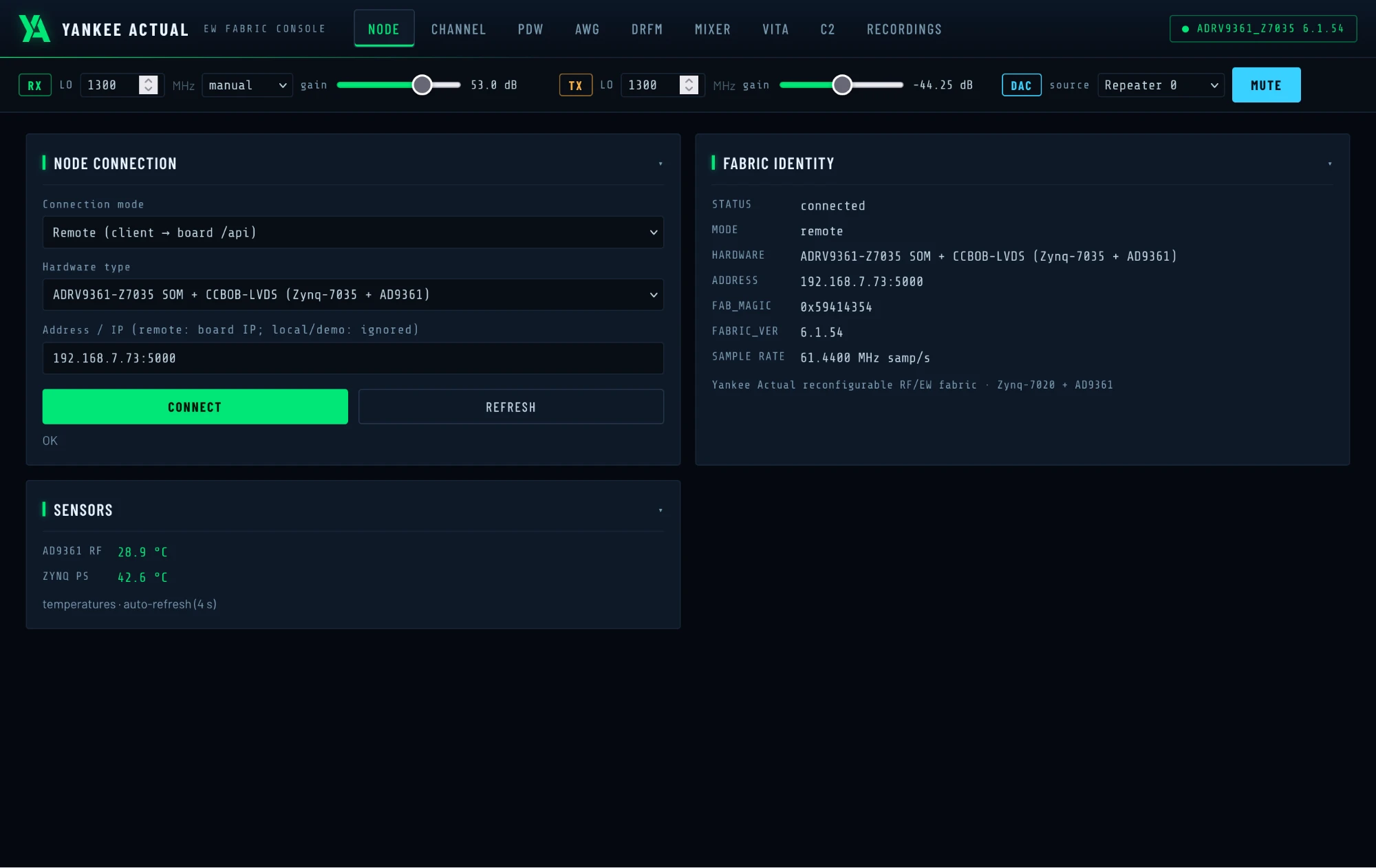
Node configuration — connect, identify, monitor. One console serves any node in the fleet.
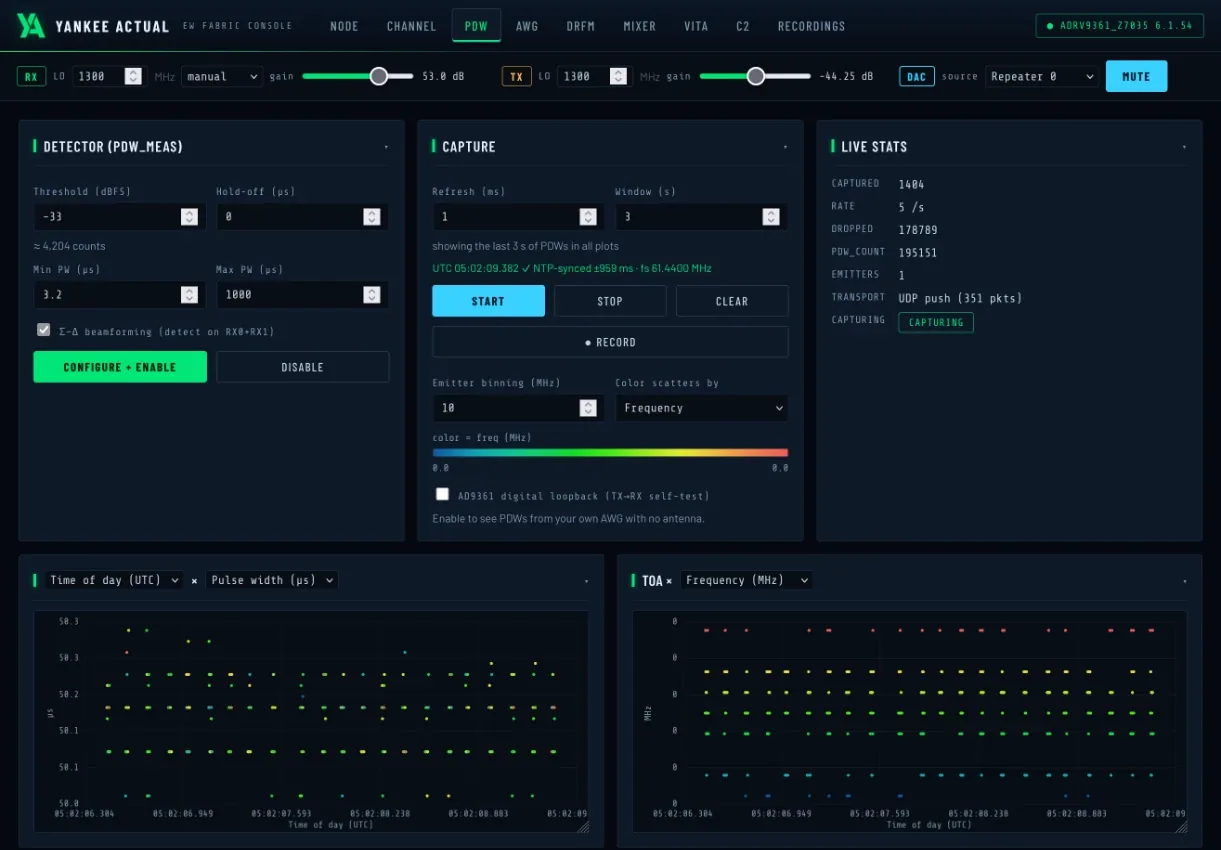
PDW survey — live pulse descriptors measured in the fabric, streamed to the browser.
Request a Briefing or Live Demo
Spectral Warrior is built and running — demonstrations are performed on real hardware, over the air. Hardware is quoted by configuration and software is licensed by tier, so node count and capability scale independently.